
A Guide to Re-engaging Lapsed Customers
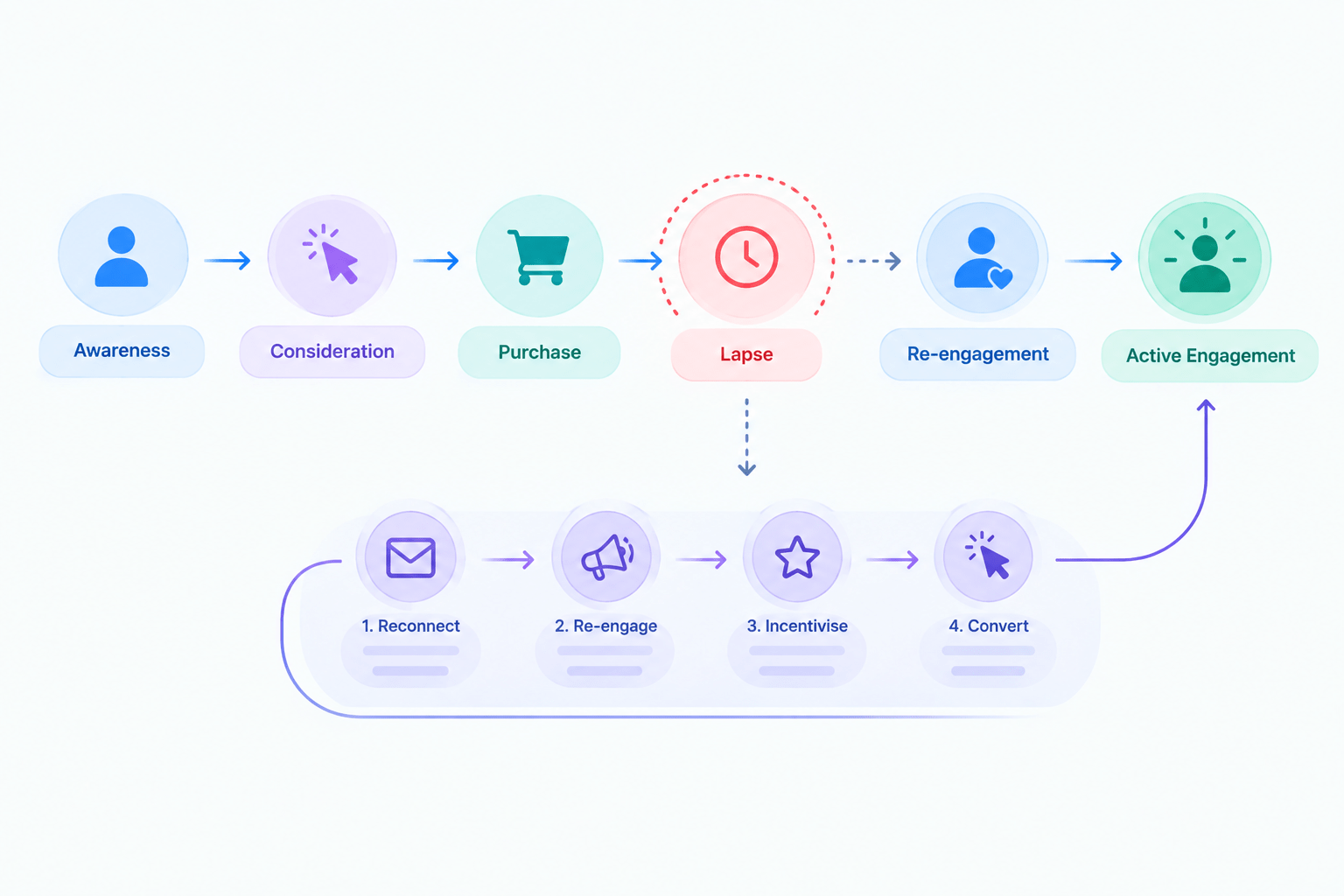
A lapsed customer isn’t a lost one, they’re someone who already went through the hardest part, deciding to trust you once. Re-engaging them is a fundamentally different, and usually cheaper, problem than acquiring someone new who’s never made that decision at all.
Re-engagement campaigns fail most often because they skip a step: assuming why a customer lapsed instead of finding out. A generic “we miss you, here’s 20% off” blast treats every lapsed customer identically, when the actual reasons someone stops buying usually cluster into a small number of genuinely different categories, each needing a different response.
Defining “lapsed” before doing anything else
“Lapsed” needs a specific, business-relevant definition before any campaign gets built, not a vague sense that someone “hasn’t bought in a while.” For a weekly grocery habit, 30 days of inactivity is a meaningful lapse. For a durable goods purchase made every few years, 30 days means nothing. Define the lapse window against the category’s actual natural repurchase cycle, and segment further by how lapsed someone is, recently lapsed customers typically respond to a fundamentally different message than customers who’ve been inactive for a year or more.
Why they actually left, versus why the team assumes
Lapses cluster into a handful of real categories worth distinguishing: price sensitivity (a competitor or substitute became more attractive on cost), a single bad experience (a specific, identifiable service failure), genuine product fit change (their needs moved, not the brand’s fault), or simple attention decay (nothing went wrong, they just stopped thinking about the brand). Each calls for a different message. A discount solves the first category and actively undersells the brand to the third and fourth, where the real barrier was never price at all.
A practical way to sort customers into these categories without guessing: look at what changed in their behaviour immediately before the lapse, not just the lapse date itself. A gradual decline in order frequency over several cycles reads differently to a hard stop immediately following a support ticket or a returned order. The pattern leading into the lapse is usually more diagnostic than any survey question asked after the fact, because it reflects what actually happened rather than how someone chooses to explain it in hindsight.
Need to put a number on your next media decision?
Model the impact of a media or marketing decision on your own numbers, browse the full library of strategic calculators and decision tools, and get definitions straight on the industry terms that come up along the way, three free resources, ready whenever you need them.
A staged re-engagement sequence, not a single blast
The sequence that outperforms a single discount blast generally runs in stages: first, a genuine value or news touchpoint with no ask attached, re-establishing relevance before requesting anything; second, if no response, a direct, specific question, often literally asking what changed, which both signals genuine interest and surfaces real segmentation data for free; third, and only then, an incentive, sized and framed based on what stage one and two revealed about why they actually lapsed. Reaching for the discount first is the most common mistake, and it’s expensive: it trains price-insensitive lapsed customers to expect one, while doing nothing for the customers whose real barrier was never about price.
Knowing when to let someone go
Not every lapsed customer is worth continued pursuit, and a re-engagement program without an exit point becomes a standing cost with no return. A defined suppression point, typically after a set number of unsuccessful re-engagement attempts, protects both deliverability (repeatedly emailing unengaged contacts damages sender reputation for the whole program) and the economics of the effort itself. The full case for why this discipline compounds is covered in Why Retention Stops At Loyalty, retention economics reward focused effort on customers genuinely worth re-engaging, not indefinite pursuit of everyone who’s ever lapsed.
Free Playbook
The Retention Economics Playbook covers building the full lifecycle case for re-engagement investment, including how to size the effort against genuine customer value.
Get the Retention Economics PlaybookRe-Engaging Lapsed Customers: FAQ
Should a discount always be the first re-engagement message?
No. Leading with a discount trains price-sensitive customers to expect one on every future lapse, and does nothing for customers whose actual barrier was a bad experience or a genuine change in product fit rather than price.
How is “lapsed” defined for a re-engagement campaign?
Against the category’s actual natural repurchase cycle, not a fixed generic window. A meaningful lapse period for a weekly purchase habit is very different from a meaningful lapse period for an infrequent, durable purchase.
When should a business stop trying to re-engage a lapsed customer?
After a defined number of unsuccessful attempts, set in advance. Continuing indefinitely damages email deliverability for the whole program and represents a standing cost without a corresponding return.
