
Why Retention Stops At Loyalty

Most retention strategies stop at the loyalty program, the easiest mechanism to build. Here’s why that’s only half the answer, and what actually works instead.
Ask most businesses what their retention strategy is, and you’ll get the same answer: the loyalty program. Points, tiers, a rewards catalogue, maybe a partner redemption or two. It’s the thing that gets built, the thing that gets a launch date, the thing a board can see and approve.
It’s also, on its own, barely half an answer.
A five percentage point improvement in retention has been shown to lift profit by a wide range depending on industry, commonly cited between 25 and 95 percent, a finding that traces back to Bain & Company’s Frederick Reichheld and has been the most-cited number in retention research for over two decades. That’s an extraordinary number for something most businesses treat as a single campaign type rather than a genuine commercial discipline. The hidden reason retention strategies stop delivering anything close to that is simple: they stop at the one mechanism that’s easiest to build, and never become the operating system they need to be.

The repeated problem
Loyalty is a mechanism. Retention is a discipline. A loyalty program rewards behaviour that’s already happened, points for a purchase, a tier for a renewal. It’s a genuinely useful piece of the picture, but it’s reactive by design, and it can only ever reward the customers who were staying anyway.
The businesses that actually move the number Bain is describing aren’t the ones with the best rewards catalogue. They’re the ones that treat retention as something designed across the whole relationship, not something that switches on at renewal time.
Why conventional thinking misses it
Acquisition gets the marketing budget and the board’s attention, because a new customer is a visible, countable win. Retention quietly determines whether that acquisition spend was worth it, but because the effect compounds silently over years rather than landing in a single campaign report, it’s chronically under-invested relative to how much value it actually protects.
That imbalance shows up in how retention gets resourced once it does get attention. Under pressure to show something, teams reach for the mechanism that’s fastest to stand up and easiest to explain to a board, a loyalty program, rather than the slower, less visible work of understanding which moments in a customer’s life actually matter to them. A points system is a real asset. It just isn’t, by itself, a strategy for knowing when to show up.
You can see the same instinct play out with employees, not just customers. A business under pressure on real retention drivers, take-home pay falling behind inflation, unclear progression, a role that’s stopped growing, will often reach for the cheapest visible gesture instead: a pizza party, a gift card, an engagement survey with no follow-through. It feels like doing something. It photographs well for a town hall. It doesn’t touch the actual reason people are leaving, and everyone on the receiving end quietly knows it. Customer loyalty programs run the same risk when they’re asked to compensate for a business that hasn’t done the harder work of knowing when and why a customer actually needs them.
The operating pattern that works
The businesses that get this right stop thinking about retention as a single campaign type and start running it as an orchestration system, five stages, each with its own triggers, working together rather than as isolated initiatives owned by different teams.
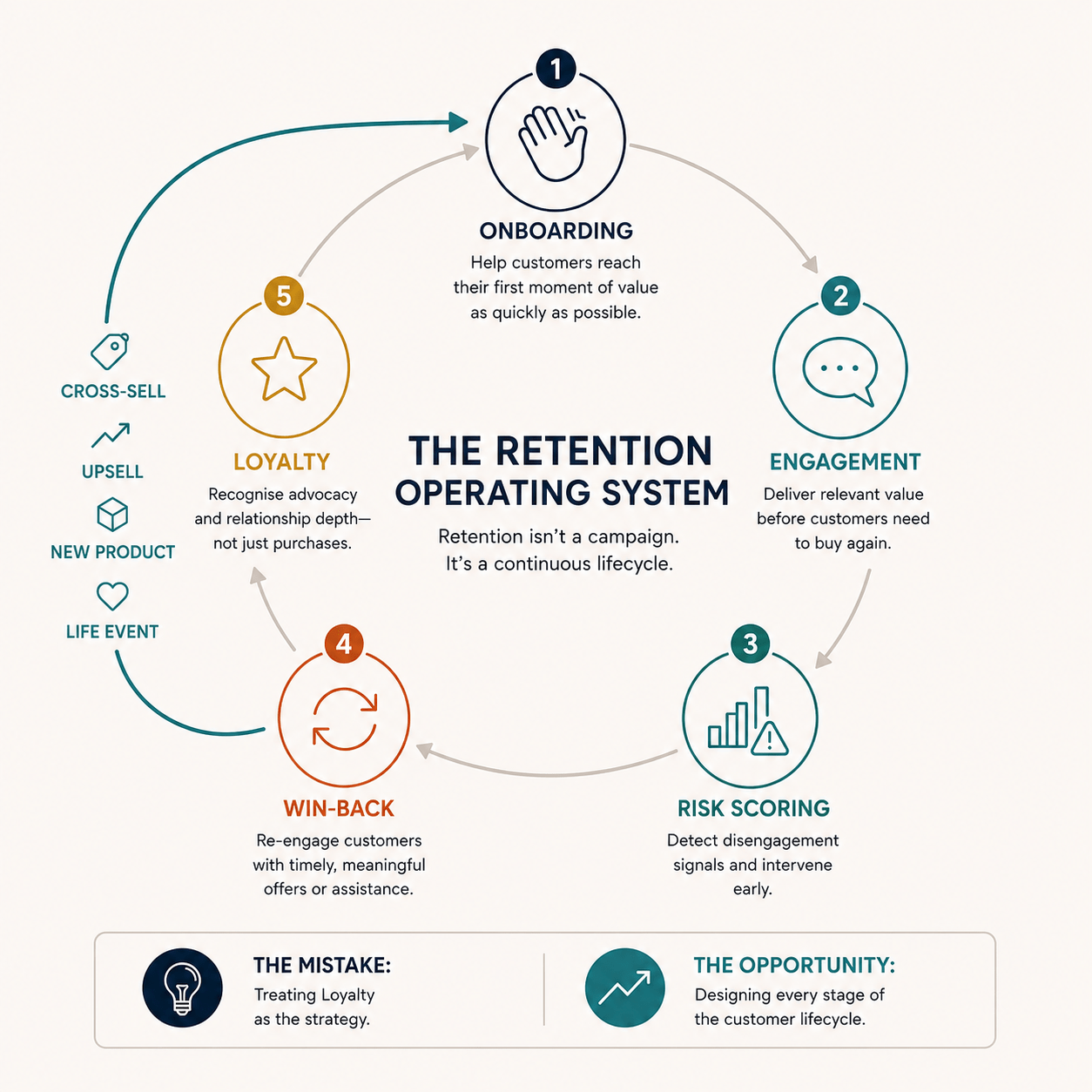
Underneath that system, three principles hold regardless of industry:
- The moment matters more than the calendar. A renewal date is the easiest touchpoint to build a campaign around, and rarely the highest-value one. The highest-value moments are behavioural and life-stage signals that require better data, not a bigger campaign budget, and they don’t arrive on a fixed schedule.
- Suppression is retention’s cheapest, fastest lever. Simply stopping irrelevant prospecting messages to people who already hold the relevant product is a cost saving and a trust-builder at the same time, and it’s usually the fastest thing to implement of anything in this list.
- Value-add earns the right to sell later. The retention programs that actually work lead with something genuinely useful at the moment it’s needed, not a hard sell, and let the commercial return follow from having earned attention first.
Australia’s major property marketplaces are a useful, publicly visible example of this last point. A property transaction happens perhaps once every seven to ten years for the average household, so a business that only shows up during that narrow active-search window is invisible to its own audience the rest of the time. That’s why you’ll see calculators, suburb guides and ownership tools built for people who aren’t currently transacting at all. It’s not content marketing for its own sake. It’s staying part of the relationship for the ninety percent of the time nobody’s buying or selling anything, so that when the moment does arrive, trust is already built.
What peers usually get wrong
The most common failure isn’t a bad loyalty program. It’s treating every touchpoint as a sales opportunity, which teaches customers to tune out all of them, including the genuinely useful ones. Close behind it is over-personalising on thin data, referencing something specific enough to feel invasive rather than helpful, when a bit more restraint would have landed better. And underneath both of those sits the quieter failure: investing in targeting the right message while never building the discipline to suppress the wrong one, which undermines the credibility of the whole program at once.
There’s a second, sneakier version of this failure that isn’t a loyalty program at all: the discretionary discount. A large insurer, faced with a customer calling to cancel, offers a one-off retention discount to keep the policy. It works, in the narrow sense that the cancellation is averted. But it teaches that customer to expect the same or better offer at their next renewal, and every renewal after that, turning what should be a relationship into a negotiation. It’s reactive, price-led, and says nothing about the customer’s actual life stage or need, which is precisely the gap a genuine lifecycle program, one that pre-empts the moment rather than reacting to a cancellation call, is built to close. Bain’s own research on rewards backs this up directly: customers who take an offer opportunistically can represent a net loss once you account for subsidising people who’d have stayed anyway, and a short-term sales lift tells you nothing about whether it built any lasting value. A discount is a sugar hit. It moves the next thirty days, not the relationship.
Curious what a 5-point retention lift is actually worth to your business?
Model the impact of a retention improvement on your own numbers, and get definitions straight on the lifecycle terms in this piece, onboarding, risk-scoring, win-back and more, two free resources, ready whenever you need them.
A short checklist
- Does your retention strategy extend meaningfully beyond the loyalty mechanism, into onboarding, engagement, risk-scoring and win-back as their own deliberate stages?
- Are you identifying real behavioural or life-stage moments, or defaulting to the convenient calendar touchpoints because they’re easier to build campaigns around?
- Do you have working suppression logic, or are existing customers still receiving acquisition messaging meant for people who aren’t customers yet?
- Is there a standing feedback loop between whoever’s designing these journeys and the customer experience or servicing teams actually hearing how they land?
- Are you measuring the relationship, retained and cross-sold lifetime value, or only the transaction, immediate conversion on a single campaign?
If most of these are still open questions, the loyalty program isn’t the problem. It’s just the one piece of a much bigger discipline that got built first.
The Retention Economics playbook goes deeper on this
Everything in this article, the five-stage operating system, why suppression is the cheapest lever, why the discretionary discount is a sugar hit rather than a strategy, is worked through in full in the free Retention Economics playbook, one of six free executive playbooks covering the recurring structural problems we see most often. No consultation required, no sales call, just the framework.
Get the Retention Economics playbook →Questions about building a real retention system
Isn’t a loyalty program still worth having?
Yes, it’s a genuinely useful mechanism for rewarding relationship depth and encouraging consolidation. The issue isn’t the loyalty program itself, it’s stopping there and calling it a retention strategy.
Does this only apply to high-consideration categories like property or automotive?
It’s most visibly powerful in long-cycle categories because the gap between transactions gives genuine value-add room to matter. The underlying discipline, lifecycle segmentation, suppression, timing to real moments, applies to faster-cycle categories too, just with a more compressed cadence.
What’s the fastest place to start if we have no lifecycle segmentation at all?
Suppression. It’s usually the fastest to implement, the easiest to build a business case for since it’s a cost saving as well as a trust-builder, and it needs the least new infrastructure of anything in this piece.
Do we need a full CDP to do any of this properly?
No. Meaningful lifecycle work can run on CRM and data-matching alone. A unified data layer makes it easier to scale and orchestrate across more channels, but the underlying discipline can start with simpler infrastructure than most people assume.
