
Gartner, Forrester Wave & Where Else to Look Before You Buy
Analyst research is one of the fastest ways to shortlist marketing, data and technology vendors, provided you know what you’re actually reading. Here’s a plain-English guide to the two names you’ll hear most, a few others worth knowing, and how to use any of them without getting played.

What “analyst research” actually means
A handful of research firms make a business out of independently evaluating technology and service vendors, then selling that evaluation to buyers as a shortcut past months of demos and RFPs. The two names that dominate marketing and data technology conversations are Gartner and Forrester. Neither is affiliated with The Media Guides. We’re pointing to them here because they’re genuinely useful starting points, with a couple of caveats below on how to read them properly.
Gartner
Best known in this space for the Magic Quadrant, a visual ranking of vendors in a given category (CDPs, marketing analytics platforms, DXPs and so on) across “completeness of vision” and “ability to execute.” Gartner also runs Peer Insights, a separate, crowd-sourced review layer built from verified customers rather than analyst opinion, which is worth checking alongside any Quadrant.
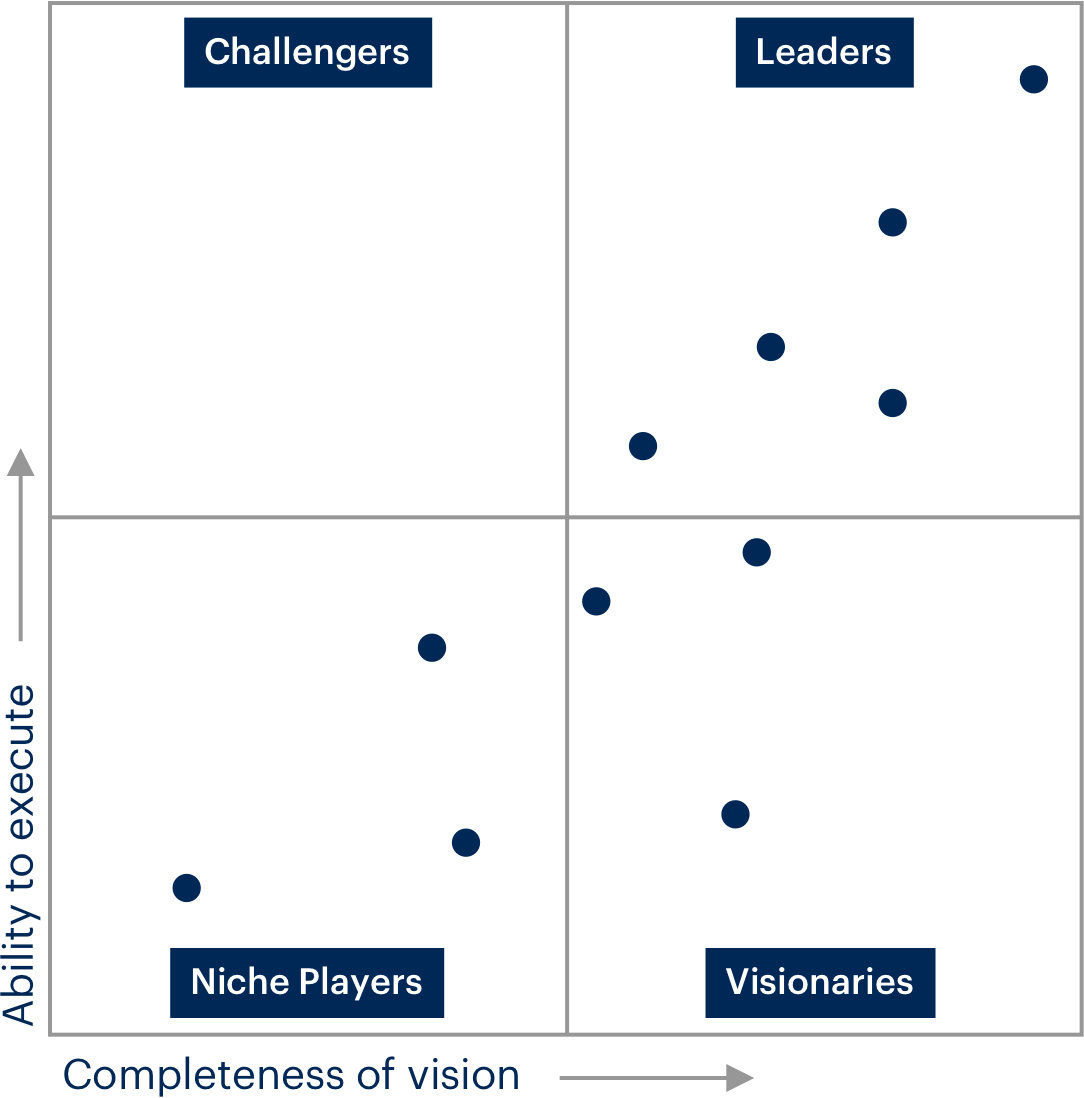 Example Magic Quadrant layout
Forrester Wave
Forrester’s equivalent format, scoring vendors against a published, weighted set of criteria specific to that Wave (current offering, strategy, market presence) rather than a single vision/execution axis. The published criteria weighting is usually the most useful part, since it tells you exactly what the analysts valued and lets you re-weight it against what actually matters for your own shortlist.
 Example Forrester Wave layout
Other research and review sources worth checking
Gartner and Forrester cover the large, established categories well, but they don’t cover everything, and their reports often lag newer entrants. These fill useful gaps:
G2 and TrustRadius in particular are worth pairing with any analyst report, since they’re built from verified user reviews rather than analyst assessment, and they surface smaller or newer vendors that haven’t yet been included in a formal Quadrant or Wave.
How to use a quadrant or wave without getting played
- Check who paid to be there. Most of these reports are built from vendors who opted in and, in some cases, pay for the detailed briefing process. A vendor’s absence doesn’t always mean they’re weak, it sometimes just means they didn’t participate.
- “Leader” reflects market size as much as fit. Placement is heavily weighted toward revenue, install base and roadmap breadth. A smaller, more specialised vendor can be the better fit for your specific problem and still sit in a lower quadrant.
- Match the report’s scope to your actual requirement. Analysts publish narrow categories (a CDP Wave is not the same as a marketing analytics Wave), so check the inclusion criteria before assuming a report covers what you think it covers.
- Cross-reference with peer reviews. Analyst research tells you strategic positioning, peer review sites tell you what implementation and support are actually like day to day. Use both.
- Treat it as a shortlist tool, not a decision. These reports are excellent for narrowing forty vendors to five. They’re a poor substitute for your own scoped evaluation against your own requirements once you’re down to a final few.
What procurement teams weigh alongside analyst research
Analyst reports are a strong starting filter, but a mature procurement process runs several other checks in parallel that Gartner and Forrester don’t attempt to cover. The gaps are consistent across most enterprise buying frameworks: total cost of ownership beyond the licence fee, security and compliance fit for your specific obligations, integration with your existing stack proven through a proof of concept rather than a demo, references from customers of a similar size and use case, the vendor’s financial stability and ownership stability, and contract terms covering exit and data portability before anything gets signed.
The matrix below is a rough guide to where a Quadrant or Wave genuinely earns its place in the process, and where it needs to hand off to your own evaluation.
| Decision area | Where analyst research adds the most value | What still needs your own evaluation |
|---|---|---|
| Market landscape | Fast, credible view of who the serious players are in a category | Confirm the report’s region and market definition actually match yours |
| Strategic vision & roadmap | Genuine signal on where a vendor is investing long-term | Doesn’t confirm the roadmap solves your problem in your timeframe |
| Total cost of ownership | Rarely covered in any depth | Build your own model: licensing, implementation, integration, internal resourcing |
| Security & compliance | High-level only, if mentioned at all | Assess directly against your obligations (Privacy Act, APRA, sector-specific rules) |
| Integration with your stack | Not covered | Prove real API and data compatibility with a POC, not a sales demo |
| References & real-world fit | Peer Insights and review platforms give a useful broad signal | Speak directly to customers of your size, industry and use case |
| Vendor viability | Market presence score is a rough, useful proxy | Check funding position, ownership changes and support continuity yourself |
| Contract & exit terms | Not covered at all | Negotiate data portability, exit costs and SLAs before signing anything |
Getting finance to say yes is its own exercise
A strong Leader placement rarely moves a finance approval on its own. Our CDP Business Case Playbook, part of the free Executive Playbooks series, walks through building the internal case for a Customer Data Platform, including the TCO and ROI framing that a Magic Quadrant or Wave simply doesn’t provide.
How management consultancies run this at enterprise scale
Firms like Accenture, BCG, McKinsey and Slalom rarely start with an analyst report at all. They start by testing whether buying beats building or extending what you already have, then run a structured, cross-functional process most in-house teams don’t have the bandwidth to replicate in full. The shape is consistent across all of them:
Build vs buy comes first. Before any vendor conversation starts, the case for buying at all is tested against extending or building on what’s already in the stack.
A weighted scorecard, not a single quadrant. Evaluation criteria are defined and weighted before outreach begins, so the shortlist isn’t shaped by whichever vendor pitches best.
Cross-functional sign-off. Security, legal, finance and the actual end users score independently. A Quadrant Leader still needs to clear all four before it moves forward.
A scoped, time-boxed pilot. Tested against your own data and workflows, not a vendor-run demo environment, with success criteria agreed before the pilot starts rather than argued about afterward.
Vendor governance starts at signature. The evaluation process converts directly into an ongoing management model the day the contract is signed, rather than ending there.
BCG’s own research has repeatedly found that most digital transformation programs stall for reasons that trace back to vendor fit and change management, not the underlying technology, which is exactly why steps 1 and 3 above carry so much weight in these processes. This is the calibre of process our own Commercial Strategy work runs, at a faster pace and without the consulting-firm price tag.
Already narrowed your shortlist and want a second opinion?
We’ve sat on both sides of these evaluations, running them internally and being evaluated as a partner. We can help sanity-check your shortlist before you sign anything.
Get a free consultCommon questions
What’s the difference between the Gartner Magic Quadrant and the Forrester Wave?
Both rank vendors in a given technology category using an independent methodology, but the frameworks differ. Gartner plots vendors on two axes (completeness of vision and ability to execute). Forrester scores vendors against a published, weighted set of criteria specific to that category, so the published weighting itself is often the more transparent part of the two.
Are Gartner and Forrester reports free to read?
Full reports usually sit behind a client subscription. Vendors placed favourably in a given report will often license the right to share or reprint it for free on their own site, which is frequently the easiest way to read one without a subscription, keeping in mind you’re reading the version the vendor chose to publish.
Should I ignore a vendor that isn’t in a Magic Quadrant or Wave at all?
No. Inclusion criteria are usually built around revenue thresholds and market presence, so smaller or newer vendors are frequently excluded regardless of product quality. Check peer review platforms like G2 or TrustRadius for vendors that fall outside the formal analyst reports.
What does an analyst report not tell me that procurement still needs to check?
Total cost of ownership, security and compliance fit for your specific obligations, integration with your existing stack, financial stability of the vendor, and contract or exit terms. None of these are meaningfully covered by a Magic Quadrant or Wave, which is why they sit in their own matrix further up this page.
Is a proof of concept still necessary if a vendor is already rated a Leader?
Yes. A Leader placement reflects market presence and vision at a category level, not whether the platform integrates cleanly with your specific stack or handles your specific data volumes. A scoped, time-boxed pilot against your own data remains the only reliable way to confirm fit before signing.
Are peer review platforms like G2 more reliable than an analyst report?
They answer a different question. Analyst reports assess strategic positioning and market direction; peer review platforms reflect day-to-day implementation and support experience from verified users. Neither replaces the other, and the strongest shortlist process checks both.
How is a management consultancy’s vendor selection process different from just reading an analyst report?
Consultancies like Accenture, BCG, McKinsey and Slalom typically start by testing build versus buy, then run a weighted scorecard, cross-functional sign-off and a structured pilot before a decision is made. An analyst report is one input into that process, usually the shortlisting step, not the process itself.
Is The Media Guides affiliated with Gartner or Forrester?
No. Gartner, Magic Quadrant and Forrester Wave are trademarks of their respective owners. We reference them here for reader education because they’re widely used, genuinely useful research tools, not because of any partnership, endorsement or affiliation.
Gartner, the Gartner logo and Magic Quadrant are registered trademarks of Gartner, Inc. and/or its affiliates. Forrester Wave is a trademark of Forrester Research, Inc. The Media Guides is not affiliated with, endorsed by or sponsored by either company. All product and company names mentioned are for identification purposes only.