
Our Guide To Making Wise Marketing Technology Investments
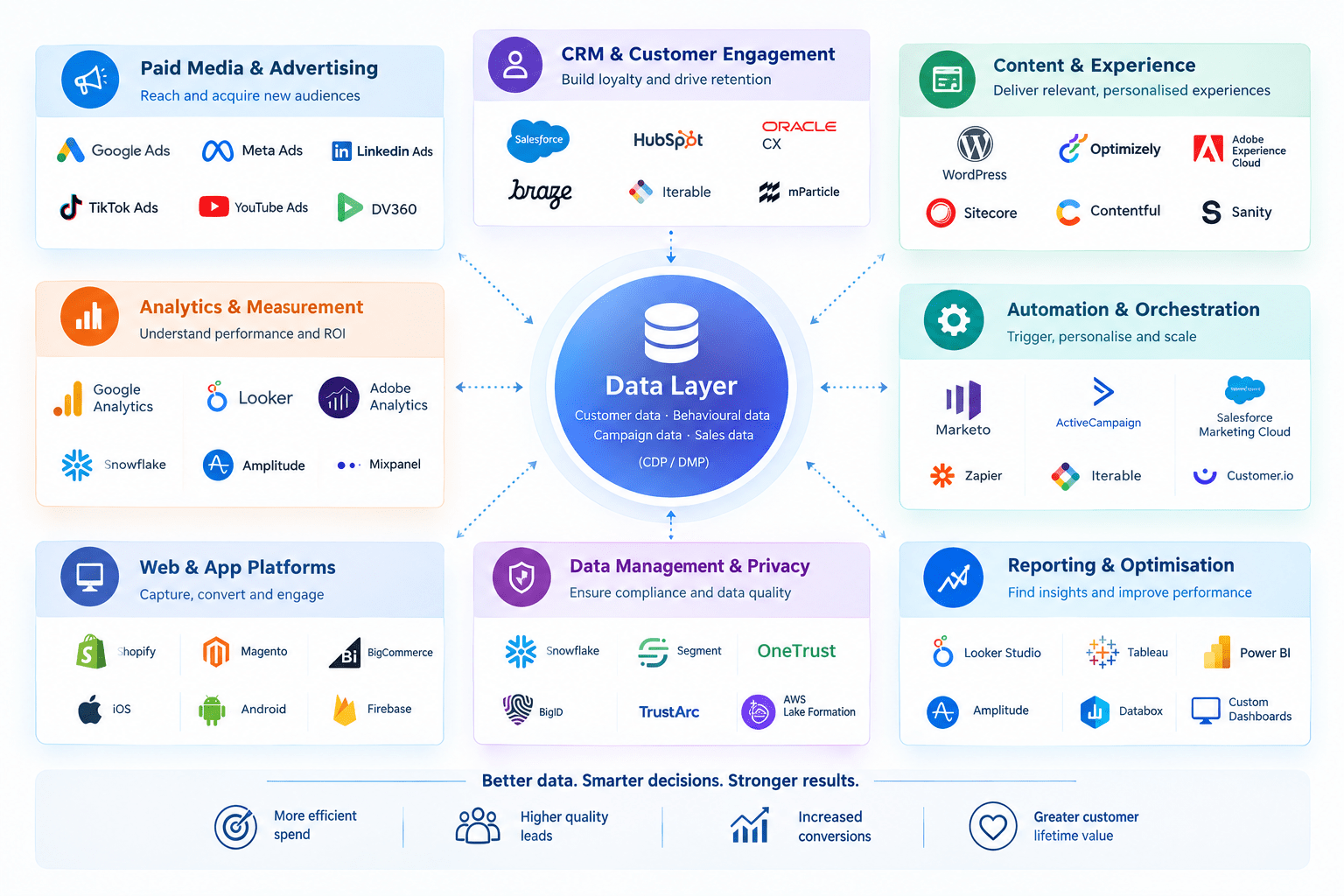
Most martech spend doesn’t fail because the tool was wrong. It fails because the roadmap didn’t exist yet when the tool was bought.
Martech budgets keep growing and satisfaction with the resulting stack keeps not matching it. That gap isn’t usually a vendor problem. It’s a sequencing problem.
The pitfall most martech reviews miss
The common failure pattern isn’t “we bought the wrong tool.” It’s “we bought a tool before we’d decided what decision it needed to support.” A platform gets shortlisted because a competitor uses it, or because a vendor pitch was persuasive, and the actual use case, the specific customer journey or reporting gap it’s meant to close, gets defined afterwards to justify the purchase rather than before to guide it.
That ordering problem compounds. Each subsequent tool gets evaluated against “does it integrate with what we already have” rather than “does it solve what we still can’t do,” and the stack grows sideways instead of towards anything. Three or four procurement cycles later, most teams are paying for overlapping capability across two or three platforms because nobody owned the question of whether the new purchase replaced something old, only whether it added something new.
It’s rarely a single bad decision that gets a stack into this state. It’s a series of individually reasonable ones, each made under time pressure, each solving a real short-term problem, with nobody ever tasked with stepping back and asking whether the collection of decisions still made sense as a whole. That’s a governance gap, not a competence one, and it’s fixable without blaming whoever made any single purchase along the way.
What a sunk-cost stack looks like from the outside
A few signs a stack has drifted into sunk-cost territory rather than deliberate design, worth checking honestly before the next procurement cycle rather than after:
- More than one platform in the stack claims to “own” the same capability, two tools both doing email orchestration, three both doing attribution.
- Nobody can say, without checking, which specific team or role is the primary owner of a given platform.
- Renewal happens because switching feels riskier than staying, not because the platform is still winning against alternatives.
- A meaningful share of licensed seats or modules are provisioned but sitting unused past the first year.
- The martech roadmap, if one exists, was last updated by a different person in a different role than whoever’s now accountable for it.
None of these individually is damning. Two or three together, in the same stack, usually means the roadmap stopped driving decisions a while ago and the vendor relationships started driving it instead.
Roadmap before stack, not the other way round
A martech roadmap that actually holds up starts with the customer journey, not the tool category. Map where the journey currently breaks or goes dark, a handoff between systems, a channel with no feedback loop, a segment you can’t act on, then work backwards to what capability would close each gap. Only once that list exists does it make sense to ask which vendor fills which gap best.
| Sequence | What it answers |
|---|---|
| 1. Map the journey and its breaks | Where does the customer experience or the data actually fail today? |
| 2. Define the capability gaps | What would need to be true for each break to close? |
| 3. Shortlist against the gap, not the category | Which vendors close this specific gap, not “which CDPs exist”? |
| 4. Evaluate on integration and total cost of ownership | Does it fit the stack you have, and what does it actually cost to run, not just to license? |
Need to put a number on your next media decision?
Model the impact of a media or marketing decision on your own numbers, browse the full library of strategic calculators and decision tools, and get definitions straight on the industry terms that come up along the way, three free resources, ready whenever you need them.
Evaluating vendors on the questions that matter
Past the shortlist stage, three questions do most of the work: what does this tool need from your data that you don’t currently have in a usable state, who internally owns it once the vendor’s onboarding team leaves, and what does the second year actually cost once discounts and implementation credits roll off. Vendors answer the first two well when asked directly. Almost none volunteer the third without being pushed.
The gap between year-one and year-two cost is where most martech budgets quietly blow out. Implementation credits, discounted onboarding, and “included” professional services hours are almost always front-loaded into the first twelve months specifically because that’s the period the buying decision gets evaluated against. Ask for the renewal-year price in writing before signing, not as a follow-up question after.
| Cost component | Often included Year 1 | Typically not included Year 2 |
|---|---|---|
| Implementation & onboarding | Yes, usually bundled | Not applicable once live |
| Training | Often included | Rarely without extra cost |
| Premium support tier | Sometimes discounted or free | Full price |
| Data volume overages | Rarely hit during pilot | Common once fully live |
None of this requires a full re-platform to start applying. The cheapest version is auditing the current stack against the roadmap you’d write today, not the one that justified each purchase at the time, and being honest about which tools would survive that test. The Tech & Services Comparison hub runs the same evaluation criteria used here, if it’s useful for benchmarking a specific shortlist before the next renewal decision.
Free Playbook
The Operating Model Playbook covers how to sequence capability and technology decisions so the stack serves the roadmap, not the other way round.
Get the Operating Model PlaybookMartech Investment: FAQ
How do we know if we actually need a new platform or just better use of what we have?
Audit actual usage of your current stack against its licensed capability first. It’s common to find a meaningful share of an existing platform’s paid features going unused, which is usually a cheaper fix than a new purchase.
Who should own the martech roadmap, marketing or IT?
Neither exclusively. It needs to be jointly owned, with marketing defining the use cases and IT owning integration and data governance, because a roadmap built by one side alone tends to either ignore feasibility or ignore the actual customer problem.
What’s a realistic timeframe for a martech roadmap to start showing results?
Expect the early months to be mostly foundational, data cleanup, integration work, with limited visible output, then results compounding as capabilities start stacking on a cleaner base rather than arriving all at once.
Should we consolidate vendors even if it means losing some capability?
Usually yes, if the capability being lost was never mapped to a real use case in the first place. Consolidating around fewer, better-owned platforms tends to beat maintaining broader coverage that nobody’s fully using.
