
Decisioning vs Capability: The Split Teams Get Backwards

Cross-functional squads and channel teams clash for a structural reason, not a personality one – here’s the split between deciding and delivering that actually fixes it.
In the last piece in this series, I wrote about why good teams still fail when the operating model underneath them was never properly designed. There’s one specific version of that failure worth its own article, because I see it constantly, and it’s rarely framed as a structural problem at all. It usually gets framed as a personality clash.
A channel team feels like the “customer” people keep parachuting in with opinions about their craft. A cross-functional squad feels like it’s constantly waiting on a channel team that has six other priorities ahead of them. Both sides are usually right about what they’re experiencing, and both sides are usually looking in the wrong place for the fix. The problem isn’t the people. It’s that nobody separated two fundamentally different jobs, deciding what should happen, and building the capability to make it happen, and then wondered why the group doing both was constantly at war with itself.
The repeated problem
Give one team both the decision rights over a customer journey and the responsibility for the channel craft that delivers it, and you’ll get one of two outcomes. Either the channel skill dominates, and every decision gets filtered through “what can we build quickly in this channel” rather than “what does the customer actually need,” or the decisioning dominates, and channel specialists spend their time executing briefs from people who don’t understand the medium well enough to brief it properly.
Split the team by channel instead, email over here, app over there, and you get the opposite failure: nobody owns the customer’s actual experience, because everyone’s optimising their own patch. A customer moving through a life event gets three separate, well-crafted, completely uncoordinated messages, because the email team, the app team and the contact centre are all doing good work in isolation.
Neither structure is wrong because the people in it are bad at their jobs. Both are wrong because they collapse two distinct kinds of accountability, deciding and delivering, into one group.
Why conventional thinking misses it
The instinct, once this pain shows up, is almost always to add a coordination layer rather than to separate the accountability properly. A weekly sync. A shared roadmap doc. A liaison role that sits between the two groups translating one language into the other. These help a little and then stop helping, because the underlying issue was never a communication gap. It was that one group was structurally set up to own two jobs that need different instincts, different cadences, and genuinely different measures of success.
This isn’t a niche insight specific to marketing or personalisation. It’s the same lesson organisations have been re-learning at scale for over a decade as they’ve tried to become genuinely agile. McKinsey’s research on agile operating models draws a near-identical distinction: cross-functional teams built to deliver an end-to-end mission, a product, a customer journey, a specific outcome, sit alongside stable, functionally-organised teams that provide the underlying skill and capacity those missions draw on. The “squads and tribes” structure popularised by Spotify and adopted by organisations like ING follows the same logic: a squad owns the mission end to end, while a “chapter”, the functional home for a given craft, owns the depth of skill and consistency of practice within that discipline. Different vocabulary, same underlying architecture.
The operating pattern that works

The split that resolves this gives each side one job, done well, rather than two jobs, done adequately.
The decisioning side (the Journey Squad, in the model this comes from) is cross-functional by design, a journey owner, marketer, product, data and CX representation, and commercial input, and it owns the what, the why and the when. It decides what experience gets delivered, to whom, and when, and it carries accountability for the actual customer and business outcome, conversion, retention, lifetime value, not for the quality of any single channel execution.
The capability side (the Home Team) is functional by design, channel teams, creative, CRM, content, martech and engineering, and it owns the how. Its job is providing specialist capability, best practice, and delivery that’s genuinely scalable, and it’s accountable for the quality, efficiency and consistency of that delivery, not for the strategic call about whether a given journey should exist at all.
The two sides run on different cadences, deliberately. The decisioning side operates on journey planning, prioritisation and performance review rhythms. The capability side operates on sprint or production cadences focused on delivery and optimisation. Trying to force both onto one shared cadence is a common, well-intentioned mistake, it looks like alignment, but it actually just means one side’s rhythm gets imposed on the other’s genuinely different type of work.
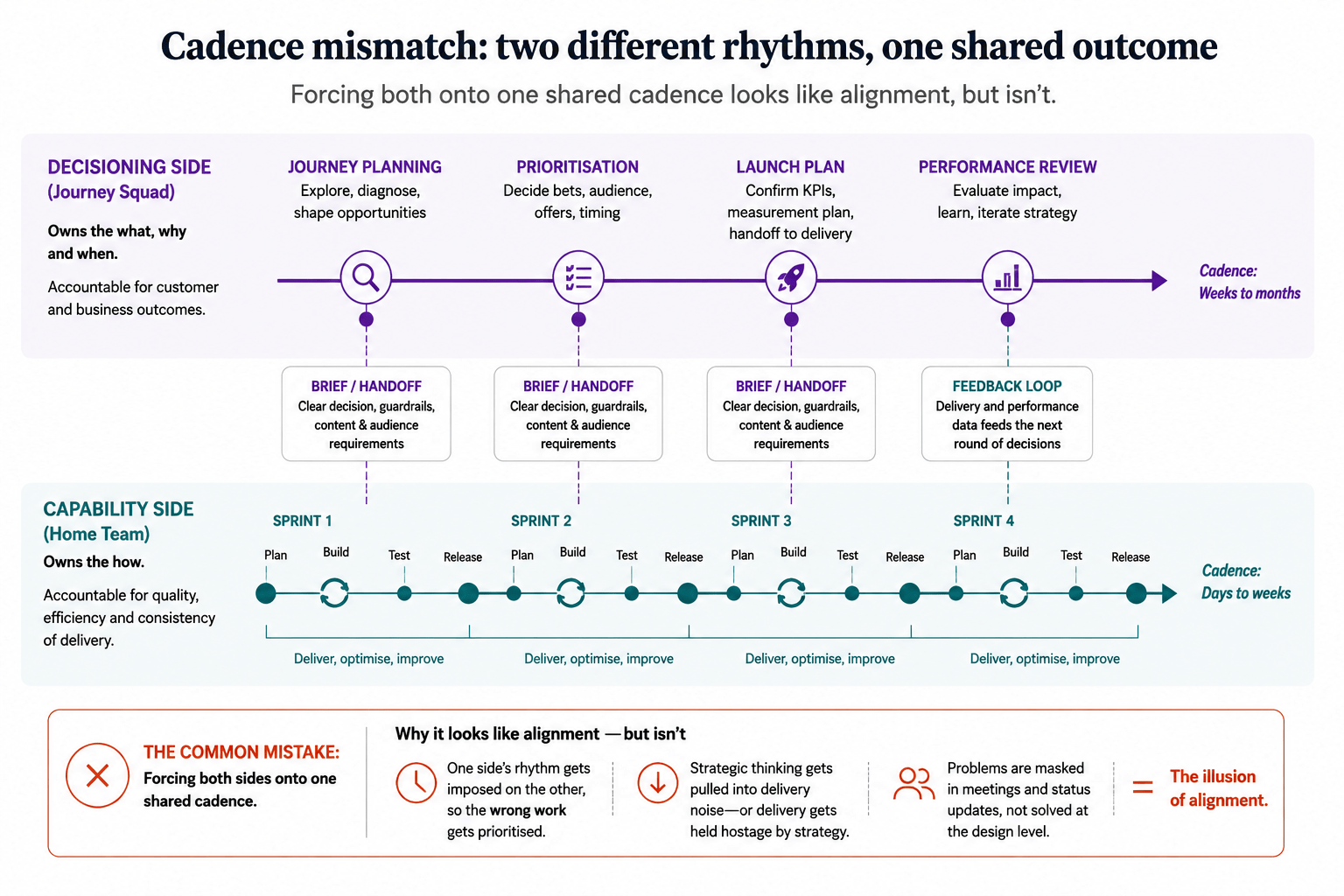
What holds the two together isn’t a shared org chart position, it’s a clean handoff: the decisioning side defines the decision clearly enough that the capability side can build against it without needing to renegotiate the strategy mid-delivery, and the capability side feeds delivery and performance data back into the next round of decisions. Clear briefs, shared metrics, and a genuine feedback loop, not just a status meeting, are what keep the two sides in the same story rather than two separate ones.
Need to put a number on your next media decision?
Model the impact of a media or marketing decision on your own numbers, browse the full library of strategic calculators and decision tools, and get definitions straight on the industry terms that come up along the way, three free resources, ready whenever you need them.
What peers usually get wrong
The most common mistake is treating this as an org chart change rather than an accountability change, renaming a channel team “the squad” without actually giving it decision rights, or standing up a cross-functional group that still has to get every call rubber-stamped by whichever functional lead has the most seniority. Nothing structural has actually moved; the confusion just gets new job titles.
The second common mistake runs the other way: giving the decisioning side so much authority that it starts dictating channel execution in detail, effectively re-absorbing the capability side’s job. When that happens, the specialist skill the functional teams were built to protect erodes, because every channel decision is being made by people without the channel expertise to make it well.
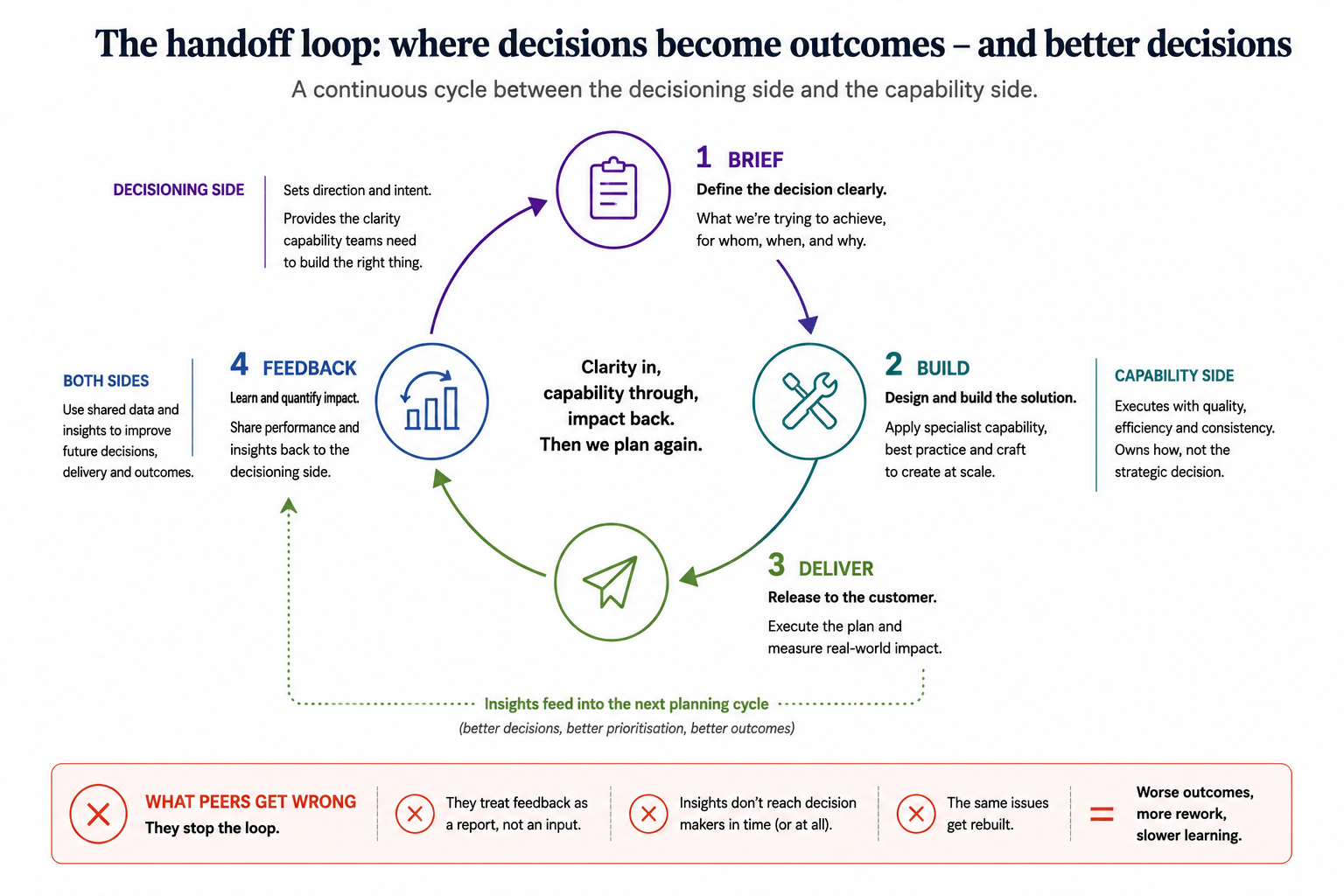
The third, subtler mistake is skipping the feedback loop. Plenty of organisations manage the initial handoff, the brief, fine, but never close the loop back from delivery performance into the next planning cycle. When that happens, the two sides drift back into separate silos anyway, just with better initial paperwork.
A short checklist
- Does one group in your organisation currently own both the “what should happen” decision and the “how do we build it” execution for the same journey or channel?
- If you asked your channel teams and your journey or product owners separately who’s accountable for a poor customer outcome, would you get the same answer from both?
- Do the two sides operate on genuinely different cadences suited to their work, or has one side’s rhythm been imposed on the other in the name of alignment?
- Is there an actual feedback loop from delivery performance back into the next planning cycle, or does the relationship reset to a blank brief every time?
- If you renamed your channel teams “squads” tomorrow without changing anything about their decision rights, would anything about how work actually happens change?
None of this is really about org charts. It’s about giving deciding and delivering the separate, well-defined jobs they actually are, letting the group closest to the customer own what happens and when, and letting the group with the deepest craft own how it gets built, then connecting the two with a clear brief and a feedback loop that actually closes. Get that right, and the “personality clash” between channel teams and cross-functional squads mostly disappears, because it was never really about personalities in the first place.
The Operating Model Playbook goes deeper on this
The decisioning/capability split in this article is one specific relationship inside the four-layer operating model, orchestration briefing execution. The free Operating Model Playbook works through the full structure, how the layers connect, where they typically break, and how to sequence a pilot properly, one of six free executive playbooks covering the recurring structural problems we see most often. No consultation required, no sales call, just the framework.
Get the Operating Model Playbook →Questions about splitting decisioning and capability teams
Does the cross-functional side need to be a permanent team, or can it be a temporary structure per project?
It works either way, and this is closer to a spectrum than a binary. Some organisations run standing squads around a persistent customer journey or persona; others stand up a cross-functional group for a defined initiative and let members return to their functional home afterward. What matters isn’t permanence, it’s that decision rights are genuinely held by the cross-functional group for as long as it exists, not quietly retained by whichever function has the most seniority in the room.
How big should a decisioning team be before this split is worth the structural effort?
There’s no fixed threshold, but the pattern earns its keep once you have more than one channel and more than one function that both need to agree on a customer journey. Below that, a single accountable owner with clear authority can often achieve the same result without a formal structural split.
What happens when the two sides genuinely disagree?
This is exactly why decision rights need to be explicit up front rather than negotiated case by case. If the decisioning side owns the what and when, and the capability side owns the how, disagreements about execution approach sit with the capability side, and disagreements about strategic direction sit with the decisioning side. Most ongoing conflict in these structures traces back to that boundary never being made explicit rather than to any single disagreement.
How does this relate to the four-layer operating model in the previous piece?
It sits directly inside it, specifically inside the orchestration and execution layers. The decisioning side maps closely to the orchestration function, and the capability side maps to the execution layer’s channel track. This piece goes deeper on that one relationship; the previous piece covers how it connects to prioritisation and governance above it.
- McKinsey & Company, “The journey to an agile organization” – cross-functional squad/tribe structures and functional “chapters” as the stable home for craft and capability
- McKinsey & Company, “Agility to action: The agile operating model” – cross-functional teams built around end-to-end missions, and the productivity and time-to-market impact of the structure
- The “squads, tribes, chapters and guilds” model, originally documented from Spotify’s engineering organisation and since adopted more broadly, including at ING
