
How Do Client-Side And Server-Side Header Bidding Setups Compare?
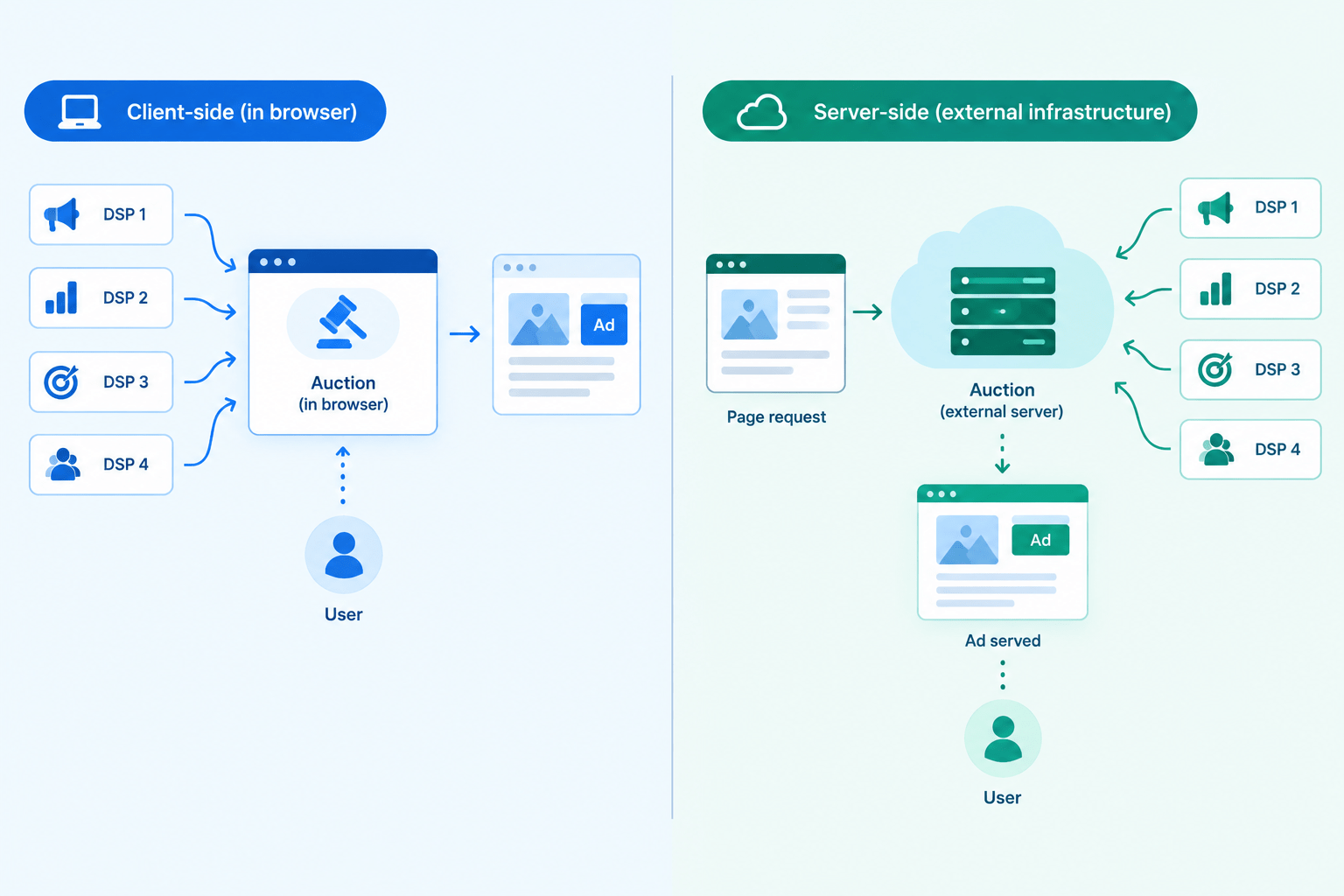
The client-side versus server-side header bidding debate has quietly resolved itself: publishers running either exclusively are the exception now, not the rule. The real decision is which demand partners belong on which side of a hybrid setup.
Client-side versus server-side header bidding used to be framed as a binary choice a publisher had to commit to. That framing is dated. The overwhelming majority of publishers now run both simultaneously, and the interesting question has moved from “which one” to “which partners belong on which side.”
The core difference, in plain terms
Client-side header bidding runs the auction inside the user’s browser: each demand partner’s code executes directly on the page, sending and receiving bid requests with full access to the browser’s cookies and first-party data. Server-side header bidding moves that auction off the page entirely: the browser makes one request, an external server fans it out to demand partners, and only the winning result returns to the page. The practical trade-off follows directly from where the auction physically happens.
In-app environments complicate the tidy version of this comparison worth knowing about. Server-side approaches like Google’s Open Bidding perform much more competitively against client-side alternatives inside apps than they do on the open web, because the data constraints that make server-side less competitive in a browser, cookie sync issues, reduced match rates, matter far less where device-level identifiers already do the identity work cookies were doing on the web.
The trade-off that hasn’t gone away
| Factor | Client-side | Server-side |
|---|---|---|
| Page load impact | Higher, each added bidder adds browser overhead | Lower, one browser request regardless of bidder count |
| Cookie and first-party data access | Full, direct browser access for every partner | Reduced, partners lose direct browser cookie access |
| Typical match rates and bid values | Higher | Lower, though the gap has narrowed as server-side technology matured |
| Number of demand partners supportable | Constrained by browser performance | Scales more easily without page-speed cost |
Why hybrid became the default, not the compromise
A few years ago, hybrid setups were framed as a reasonable stopgap while server-side technology matured. That framing is now outdated on its own terms: modern browsers and well-optimised bidding wrappers handle large client-side bidder counts without the performance penalty that originally justified moving everything server-side. The genuinely current advice from publisher-side technology guides is closer to the opposite of the old default: run a bidder client-side wherever that’s feasible, and use server-side specifically to extend reach to additional demand partners the browser genuinely can’t support without a real performance cost.
Need to put a number on your next media decision?
Model the impact of a media or marketing decision on your own numbers, browse the full library of strategic calculators and decision tools, and get definitions straight on the industry terms that come up along the way, three free resources, ready whenever you need them.
How to actually decide which partners go where
A practical starting split: keep the handful of highest-performing, highest-match-rate demand partners client-side, where they retain full cookie and first-party data access and typically deliver the strongest bid values. Route additional, lower-priority demand server-side to scale reach without degrading page performance for every visitor. Revisit the split periodically rather than treating it as a one-time configuration decision, since partner performance and browser capability both shift over time. Worth noting given the Privacy Sandbox reversal covered in The Role of Adtech in the Privacy Sandbox Era: the decline of third-party cookies has had measurably less impact on header bidding economics than the industry predicted a few years ago, since cookies were never the only signal these auctions relied on.
Free Playbook
The Retention Economics Playbook and Operating Model Playbook both touch on the yield-side decisions covered here, evaluating infrastructure investment against actual, measured performance rather than default configuration.
Get the Executive PlaybooksClient-Side vs Server-Side Header Bidding: FAQ
Is server-side header bidding always better for large publishers?
Not automatically. It scales demand more easily without page-speed cost, but typically at some reduction in match rate and bid value compared to client-side, since partners lose direct browser cookie access. The right split depends on which specific partners matter most to a given publisher’s revenue.
Should new publishers start with client-side or server-side?
Most current guidance favours starting client-side with a small number of high-performing partners, since modern wrappers handle that without a meaningful performance penalty, and adding server-side capacity as demand needs genuinely exceed what client-side can support.
Has cookie deprecation made server-side header bidding more important?
Less than originally predicted. Since Chrome ultimately kept third-party cookies rather than deprecating them, the urgency behind shifting toward server-side specifically for privacy reasons has reduced, though server-side’s other benefits, particularly scaling demand without page-speed cost, remain unchanged.
