
Ad Viewability: Considerations for Marketers and Publishers
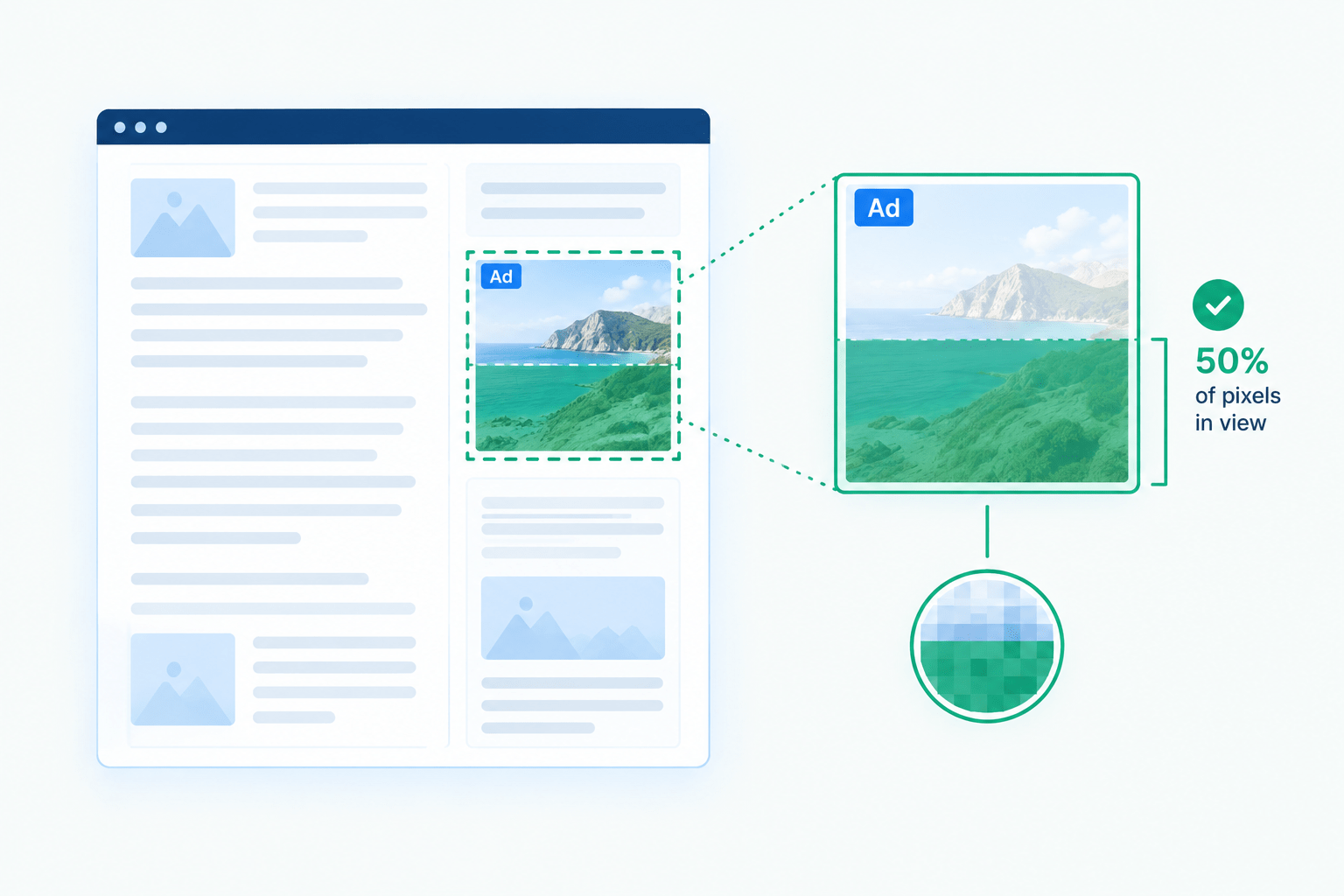
A “viewable” impression and an impression someone actually noticed are two different things, and most reporting still treats them as interchangeable. The MRC standard sets the bar for the first. Nothing yet sets a universal bar for the second.
“Viewability” gets used loosely, sometimes as a synonym for whether an ad worked. The actual definition is much narrower and much more mechanical than that, and knowing the difference matters when a vendor reports a viewability rate that sounds reassuring.
The actual standard, in specific numbers
The Media Rating Council defines a viewable display impression as one where at least 50% of an ad’s pixels are visible in a browser tab for a minimum of one continuous second following render. Video carries a stricter threshold, typically requiring two continuous seconds. Large display formats have their own adjusted pixel-percentage rules given their size. None of this measures attention, engagement, or recall, it measures whether the ad had a technical opportunity to be seen at all.
The one-second and two-second thresholds aren’t arbitrary round numbers, they came out of research into how long a person’s eye actually needs to register a static versus moving image. That’s worth knowing because it explains why video’s bar is stricter: a viewer’s gaze needs meaningfully longer to process motion and message together than it does to register a static ad’s presence, which is also part of why video CPMs carry a premium over display in most markets.
Why MRC accreditation matters more than a vendor’s own claim
The Media Rating Council, a non-profit industry body established in 1963 that audits measurement services across digital, TV, radio and print, currently accredits roughly 110 research products. Accreditation isn’t a marketing badge, it requires full methodological disclosure and an independent audit against MRC’s Minimum Standards. Recent examples show the accreditation landscape is still actively moving: HUMAN Security earned MRC accreditation for viewability across desktop, mobile web and app in April 2026; DoubleVerify became the first provider accredited for TikTok video viewability that same month; and Integral Ad Science earned accreditation covering Amazon DSP impressions, viewability and invalid traffic in late 2025. A vendor’s self-reported viewability rate and an MRC-accredited one are not the same claim, even when the number looks identical on a dashboard.
Need to put a number on your next media decision?
Model the impact of a media or marketing decision on your own numbers, browse the full library of strategic calculators and decision tools, and get definitions straight on the industry terms that come up along the way, three free resources, ready whenever you need them.
Viewable isn’t the same as seen
An impression can clear the MRC’s 50%-for-one-second bar and still never register with the person scrolling past it. That gap is exactly why attention metrics, dwell time, interaction rate, scroll-adjusted exposure duration, have been gaining ground as a complementary layer rather than a replacement, the same shift covered in the Media Mastery archive here. Viewability answers “could this have been seen.” Attention metrics are the closer, still-maturing attempt to answer “was it actually noticed.”
What to actually check before trusting a viewability number
Three questions worth asking of any viewability report: is the underlying measurement product MRC-accredited for the specific environment being reported on, desktop, mobile web, mobile app and CTV are frequently accredited separately, not as one blanket claim; is invalid traffic filtered before the viewability calculation runs, since an inflated denominator of bot traffic quietly improves a viewability percentage without improving anything real; and does the reported rate match the format actually purchased, since a video viewability standard applied to what’s functionally a display placement, or vice versa, produces a number that looks precise but measures the wrong thing.
Free Playbook
The FSI Marketing Playbook covers building media quality and verification standards suited to advertisers who need to defend every reported number, viewability included.
Get the FSI Marketing Playbook- HUMAN Security, “HUMAN Ad Viewability Measurement Earns MRC Accreditation” (27 April 2026)
- DoubleVerify, “DoubleVerify First Measurement Provider to Earn MRC Accreditation for TikTok Video Viewability Reporting” (23 April 2026)
- Integral Ad Science, “Integral Ad Science Earns MRC Accreditation for Reporting of Impressions, Viewability and Invalid Traffic on Amazon Properties” (13 November 2025)
Ad Viewability: FAQ
What’s the MRC’s exact definition of a viewable impression?
At least 50% of an ad’s pixels visible in the browser tab for a minimum of one continuous second for display, or two continuous seconds for video, with adjusted thresholds for large-format ads.
Does a high viewability rate mean an ad was effective?
No. Viewability measures the technical opportunity to be seen, not attention, engagement, or recall. A fully viewable impression can still go completely unnoticed by the person it was served to.
Is every vendor’s viewability measurement MRC-accredited?
No, and accreditation is often granted per environment rather than as one universal claim, meaning a vendor accredited for desktop viewability isn’t automatically accredited for mobile app or CTV measurement as well.
