
What Is Apple’s Private Click Measurement?
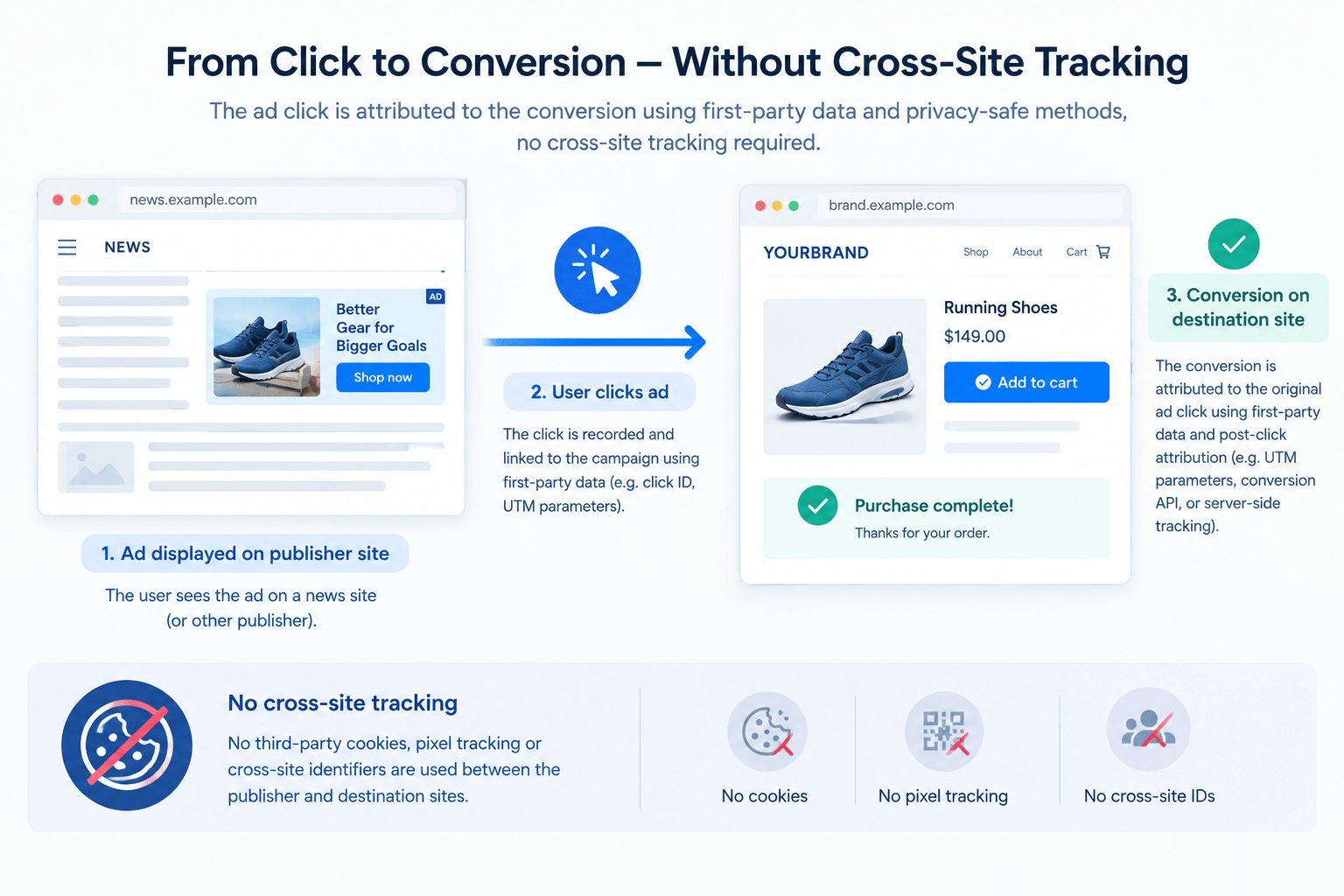
Private Click Measurement still does what it always did, but Apple’s folding the name into a bigger framework. Here’s what PCM actually measures, what it’s becoming, and what that means if you’re measuring Safari traffic.
Private Click Measurement (PCM) is Apple’s privacy-preserving way of telling you an ad click led to a conversion, without letting anyone track the person across sites to find out. It’s still doing that job. Apple’s just in the process of putting a bigger name on it.
What PCM actually does
PCM works entirely inside WebKit, the engine behind Safari. When someone clicks an ad, Safari attaches an anonymised, privacy-preserving signal to the click. If that person converts on the destination site within a set attribution window, Safari fires a delayed, aggregated attribution report back, confirming that a click led to a conversion, without exposing anything that identifies the individual or links their activity across the two sites. Users are opted in by default and can opt out through Safari’s privacy settings; if they do, no click metadata is stored and no report is sent.
The scope is specifically web-to-web and app-to-web. A click on a web ad that converts on a website is covered. An in-app ad click that leads to a web conversion is also covered. What PCM does not do is app-to-app or app-install attribution, that’s SKAdNetwork’s job, a related but separate framework for the app side.
Why “PCM” is becoming “Web AdAttributionKit”
At WWDC 2024, Apple introduced AdAttributionKit as an umbrella framework, with App AdAttributionKit building on SKAdNetwork and Web AdAttributionKit building on PCM. The underlying mechanics haven’t fundamentally changed, but the product names Apple wants developers and advertisers using going forward have. “PCM” is still the term most of the industry searches for and still technically accurate for the mechanism itself, which is why it’s used throughout this article, but Apple’s own current documentation increasingly refers to the web-side framework as Web AdAttributionKit.
Practically, this matters less for strategy and more for where you look things up. If you’re checking Apple’s current developer documentation rather than older explainers (including, for now, this one before this rewrite), search for AdAttributionKit rather than PCM to find the maintained version.
Need to put a number on your next media decision?
Model the impact of a media or marketing decision on your own numbers, browse the full library of strategic calculators and decision tools, and get definitions straight on the industry terms that come up along the way, three free resources, ready whenever you need them.
What this means for measuring Safari traffic
If your measurement stack relies on cross-site identifiers, cookies, fingerprinting, or anything that assumes visibility into a user across two separate domains, PCM (or Web AdAttributionKit, same underlying constraint) is the reason Safari traffic has always under-reported against that model, and will keep doing so regardless of the name on the framework. The aggregated, delayed nature of the reporting means real-time, individually attributed conversion data was never on the table for Safari users who haven’t opted out, and no rename changes that.
| Web AdAttributionKit (was PCM) | App AdAttributionKit (was SKAdNetwork) | |
|---|---|---|
| Covers | Web-to-web and app-to-web ad clicks | App installs and in-app conversion events |
| Where it runs | WebKit / Safari | iOS and iPadOS at the OS level |
| Reporting | Aggregated, delayed, privacy-preserving | Aggregated, delayed, privacy-preserving |
| Doesn’t cover | App-to-app attribution | Web conversions from app-sourced clicks |
Practically, this pushes measurement strategy in the same direction it’s been pushed for several years: incrementality testing and modelled attribution as the primary read on Safari-heavy audiences, with PCM or Web AdAttributionKit’s aggregated reports as a directional confirmation rather than a source of individual-level truth.
What’s worth checking now, specifically because of the rename rather than despite it: if your measurement or attribution vendor’s documentation still exclusively references “PCM” or “SKAdNetwork” with no mention of AdAttributionKit, it’s worth asking them directly whether they’re tracking Apple’s current framework or working from an older integration that predates it. The underlying data hasn’t changed, but vendors slow to update their own documentation are sometimes also slow to pick up framework-level changes that do eventually matter, like new conversion window options or reporting granularity Apple’s added under the new name.
None of this changes the fundamental measurement posture Safari traffic has required for years now: treat any individually-attributed, real-time conversion number as directionally useful at best, build actual decision-making on modelled and incremental measurement that doesn’t depend on identifiers Apple was specifically built to withhold, and use PCM’s own aggregated reports as one confirming signal among several rather than the definitive read.
Free Playbook
The Retention Economics Playbook and the Customer Data Strategy engagement model both cover building measurement approaches that don’t depend on identifiers platforms like Safari were specifically built to withhold.
Get the Executive PlaybooksApple’s Private Click Measurement: FAQ
Is PCM the same as SKAdNetwork?
No. PCM (now increasingly called Web AdAttributionKit) covers web-to-web and app-to-web attribution inside WebKit and Safari. SKAdNetwork (now App AdAttributionKit) covers app install and in-app event attribution at the iOS level. They’re related in privacy approach but cover different traffic entirely.
Do users need to do anything for PCM to work?
No. Users are opted in by default, with the option to turn it off through Safari’s privacy settings. If a user opts out, no click metadata is stored and no attribution report is sent for that user’s activity.
Does PCM replace third-party cookies for attribution?
Not directly, it’s a narrower, purpose-built replacement for one specific job, click-to-conversion attribution, not a general substitute for everything cross-site cookies used to enable. Most teams pair it with modelled attribution and incrementality testing rather than treating it as a like-for-like swap.
