
Customer Data Platform (CDP) Considerations: Do You Actually Need One?
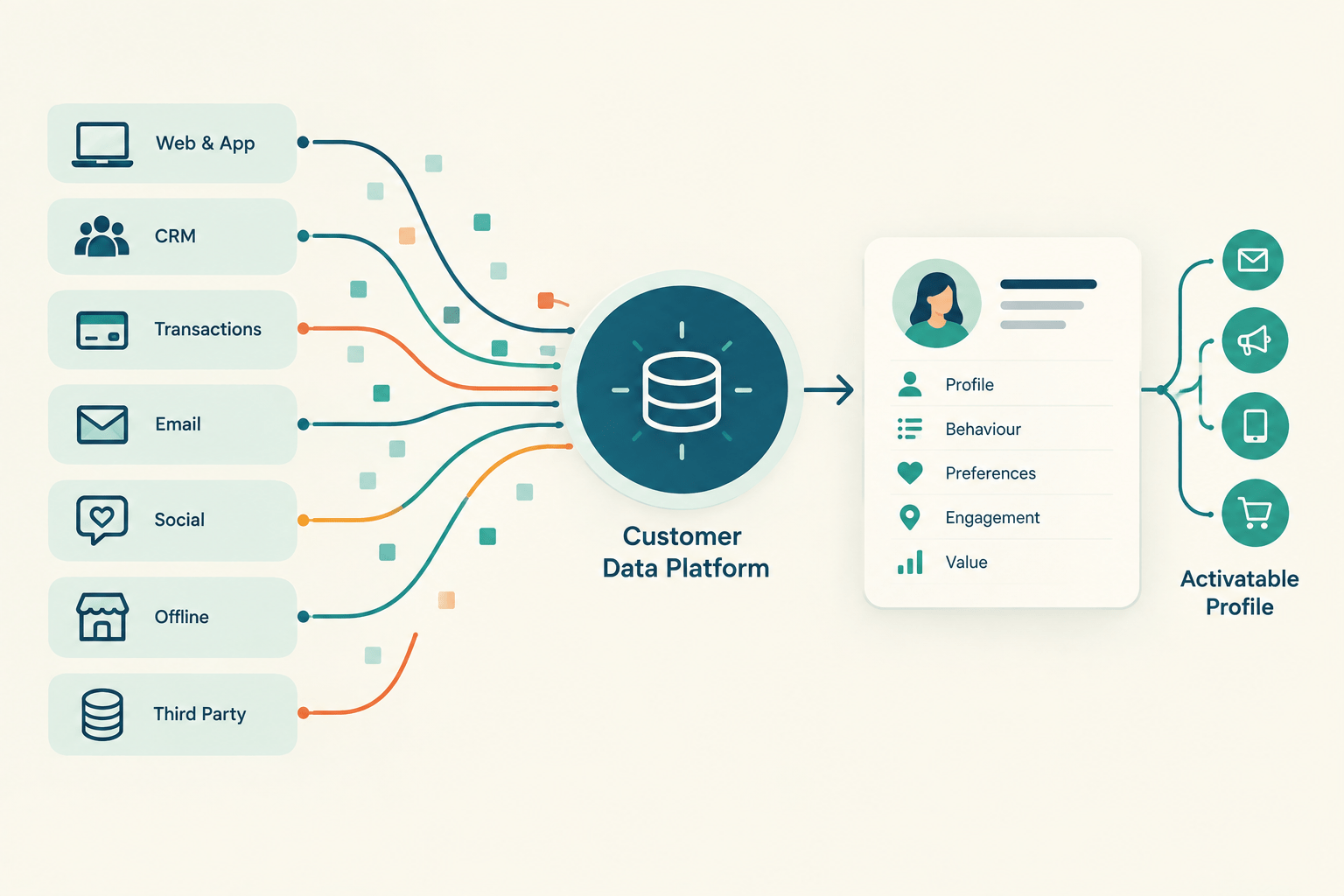
A CDP isn’t a default answer to a personalisation or data problem. It’s the right tool for a specific situation, and the wrong one for several others that look similar from the outside.
“Do we need a CDP?” is usually the wrong first question. The right one is “what decision are we trying to make that we currently can’t,” and a CDP is one possible answer to that, not the default one.
What a CDP actually solves
A customer data platform’s job is narrow: unify identity and behaviour signals scattered across your CRM, web analytics, ad platforms and transaction systems into a single profile that other tools can activate against. Not report on, activate against. That’s the distinction that separates a CDP from a dashboard or a data warehouse. A CDP exists to be queried in real time by the systems that talk to the customer, not just by the analyst reviewing last month’s numbers.
That’s genuinely valuable when the fragmentation itself is the blocker: you know what you’d do with a unified profile, you just don’t have one. It’s a much weaker case when the actual blocker is somewhere else, a broken attribution model, an under-resourced lifecycle team, a data governance gap that no platform fixes, and a CDP just becomes an expensive way of not fixing that.
The confusion usually starts with category overlap. A DMP does something similar but works mostly with anonymous, cookie-based audience data for media targeting, and most have been quietly winding down as third-party cookies do the same. A CRM holds known-customer records but rarely sees anonymous or pre-purchase behaviour. A data warehouse can technically store all of it, but wasn’t built to be queried in real time by an email platform mid-send. A CDP’s whole reason to exist is sitting in the gap between those three.
Three questions worth asking before you buy one
In order, because each one gates the next:
| Question | What it’s really testing |
|---|---|
| Is there a specific, named use case waiting on this? | Not “better personalisation” in general. A campaign, a journey, a segment that can’t be built today because the data lives in three places. |
| Is your existing stack genuinely unable to do it? | A well-configured CRM or a couple of well-built pipelines into your warehouse solve more of this than most teams assume before they check. |
| Is the data itself in a state a CDP can actually unify? | Garbage in, garbage unified. If identity resolution is broken at the source, a CDP inherits the mess, it doesn’t fix it. |
If the answer to the first question is vague, stop there. A platform bought to solve “personalisation” in the abstract almost never gets used the way it was pitched, because nobody scoped what it was actually for.
What “good” activation actually looks like
It’s worth being concrete about what “activation” means in practice, because the term gets used loosely enough to mean almost anything. Three examples that are genuinely CDP-shaped problems: suppressing a customer from an acquisition campaign the moment they convert, regardless of which channel captured the conversion; triggering a lifecycle message off a real-time behavioural signal, like cart abandonment or a support ticket, rather than a batch job that runs once a day; and building a lookalike or propensity segment from a unified profile that blends offline purchase history with online browsing, something a DSP alone can’t do because it never sees your CRM data.
None of those are exotic. They’re also all things a fragmented stack technically can approximate with enough manual stitching, which is usually how the “do we actually need this” conversation starts: someone on the team is already doing this by hand, badly, and the business case writes itself once that’s visible.
The alternatives worth ruling out first
Before shortlisting vendors, it’s worth ruling out three cheaper options, because each one solves a meaningful slice of what people assume needs a CDP. A well-configured CRM with decent API access covers more real-time personalisation than most teams expect, particularly for known-customer journeys. A reverse-ETL pipeline into your existing warehouse, feeding tools like your ESP or ad platforms directly from cleaned first-party data, closes a surprising amount of the activation gap without a new platform at all. And for pure audience-building without individual-level personalisation, your ad platforms’ native first-party data matching tools sometimes get you most of the outcome for a fraction of the implementation cost.
None of these replace a CDP when the use case genuinely needs one. But ruling them out first is what keeps a business case honest, rather than a foregone conclusion dressed up as an evaluation. If you’re comparing specific platforms once you’ve ruled these out, the Tech & Services Comparison hub runs CDPs, DMPs and CRMs through the same evaluation criteria used here.
Need to put a number on your next media decision?
Model the impact of a media or marketing decision on your own numbers, browse the full library of strategic calculators and decision tools, and get definitions straight on the industry terms that come up along the way, three free resources, ready whenever you need them.
Where this shows up in real programs
A cross-functional CDP business case I built at Gumtree (GCA) is a useful example of getting the sequencing right: commercial, marketing, editorial, product and finance stakeholders aligned around specific use cases before the platform decision, not after. That business case secured funding and became one of the company’s five annual strategic initiatives, precisely because it was scoped as “here’s what we’ll be able to do that we can’t do now,” not “we should have a CDP.” More on that specific engagement is covered on Business Challenges.
The failure mode I see more often runs the other way: platform selected first, use cases retrofitted afterwards to justify the spend. That’s usually where the value gap between what was pitched and what gets used shows up eighteen months later, when someone asks why the platform that was meant to transform personalisation is mostly being used as an expensive segment-export tool.
| Tool | Best at | Weak at |
|---|---|---|
| CDP | Real-time, cross-channel activation from a unified profile | Ad-hoc analysis, being the system of record |
| CRM | Known-customer relationship and sales/service data | Anonymous, pre-purchase behaviour |
| DMP | Anonymous audience building for media targeting | Individual-level personalisation, cookieless environments |
| Data warehouse | Historical analysis, reporting, storage at scale | Real-time queries mid-campaign |
Free Playbook
The CDP Business Case Playbook walks through exactly this sequencing: stakeholder alignment, use case definition and the business case structure that gets a CDP funded for the right reasons.
Get the CDP Business Case PlaybookCDP Considerations: FAQ
What’s the difference between a CDP and a CRM?
A CRM is built around known, identified customer relationships, usually sales or service-led. A CDP is built to unify identity across both known and anonymous touchpoints, including ones your CRM never sees, like ad exposure or anonymous site behaviour, and make that unified profile queryable in real time.
Do we need a CDP if we already have a data warehouse?
Not necessarily. A warehouse is built for analysis and reporting. A CDP is built to be activated against by other systems in real time. If your need is better reporting, a warehouse solves it. If your need is real-time activation across channels, that’s the gap a CDP fills.
What’s the most common reason a CDP implementation underdelivers?
The platform gets selected before the use case is defined. Without a specific, named use case driving the build, teams end up with a well-unified dataset and no clear answer to “unified for what.”
How long does a CDP implementation typically take?
It varies significantly with data source complexity and identity resolution quality going in, but expect a meaningful gap between “live” and “fully activated.” Getting data flowing in is usually the fast part. Getting every downstream system properly querying it is the slower one.
