
Will Cloud-Based Collaboration Survive in a Post-Cookie Era?
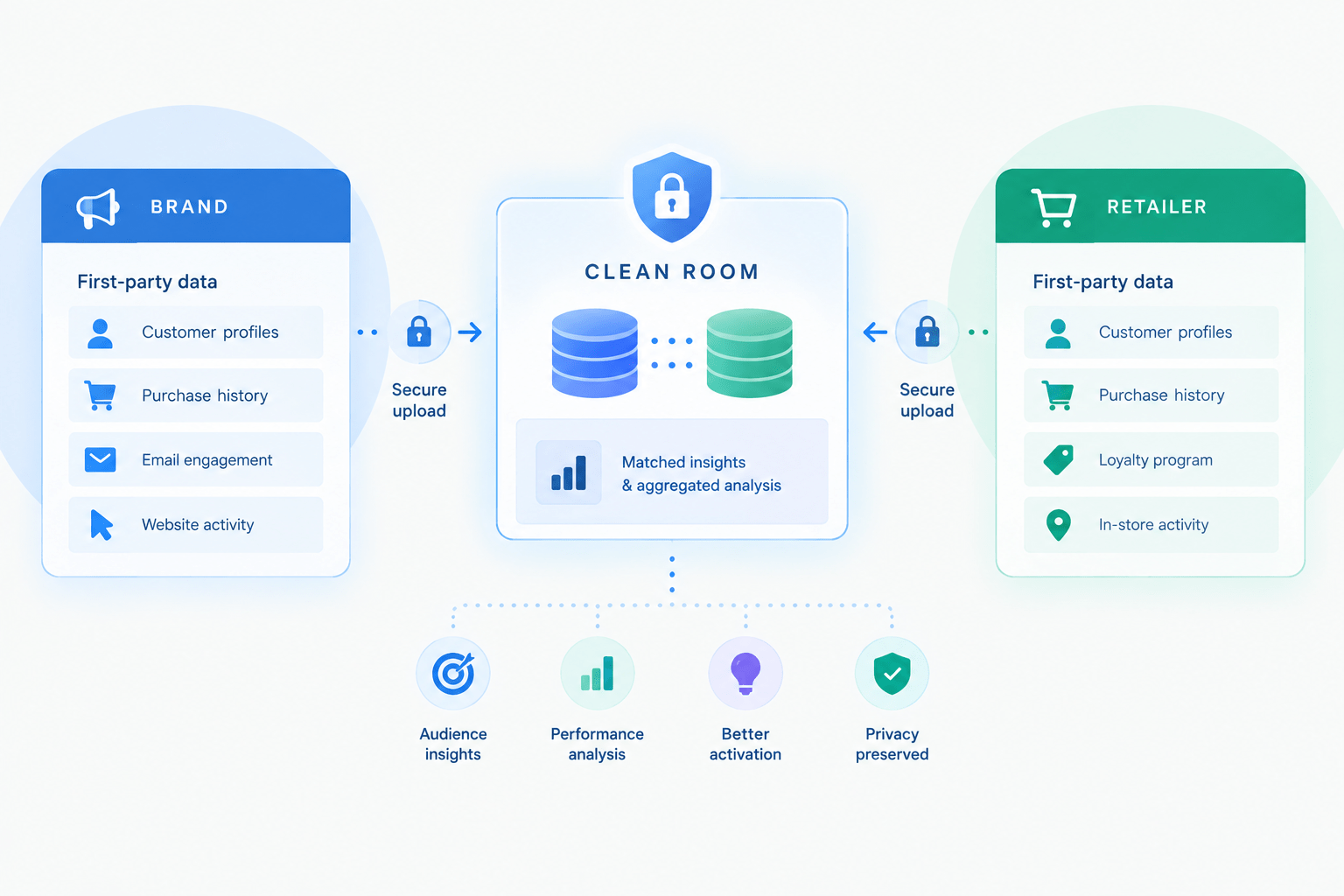
Data clean rooms were pitched as a cookie-deprecation contingency. Chrome kept cookies anyway. Clean room adoption grew regardless, because the actual demand driver was always retail media’s need to collaborate on first-party data, not a browser policy.
“Cloud-based collaboration” was industry shorthand for data clean rooms, positioned a few years ago as essential infrastructure for a cookieless future that was coming whether the industry was ready or not. Chrome’s cookie reversal, covered in The Role of Adtech in the Privacy Sandbox Era, removed that specific deadline. Clean room adoption kept growing anyway, which is the more interesting story.
The real adoption driver was never the cookie deadline
Clean rooms solve a problem that exists independently of any browser’s cookie policy: how a brand and a retailer, each holding valuable first-party data neither wants to hand over in raw form, can still collaborate on audience matching and closed-loop measurement. Retail media’s growth made this problem urgent on its own terms, since the entire retail media pitch depends on connecting ad exposure to actual purchase data without either party surrendering control of that data to the other.
Worth separating two things that get conflated: clean rooms as a response to browser-level cookie policy, and clean rooms as a response to a genuinely different, harder problem, two separate companies with separate customer relationships trying to collaborate without either one becoming the other’s data processor by default. Even in a world where every browser kept third-party cookies forever, that second problem would still exist, and would still need solving. That’s the tell that clean room demand was never really about Chrome.
The numbers, and the gap they reveal
| Metric | Figure |
|---|---|
| Organisations using clean rooms in some capacity | 66% |
| US retail media networks currently offering clean room capability | 48% |
| US retail media ad spend, 2026 | Approaching $70-71 billion |
Source: eMarketer, 2025 State of Retail Media report
The gap between those first two figures is the real story: two-thirds of organisations already use clean room technology in some form, but under half of retail media networks have actually built the capability to offer it. That’s a genuine competitive opening for any retail media network still weighing whether clean room infrastructure is worth the investment, and a real due-diligence question for any brand evaluating which retail media partners can actually deliver the closed-loop measurement their pitch decks promise.
Need to put a number on your next media decision?
Model the impact of a media or marketing decision on your own numbers, browse the full library of strategic calculators and decision tools, and get definitions straight on the industry terms that come up along the way, three free resources, ready whenever you need them.
What a clean room actually does, in plain terms
Two organisations each upload their own first-party data into a secure, neutral environment. The platform matches records between the two datasets, a brand’s customer list against a retailer’s purchase history, for example, without either party ever seeing the other’s raw underlying data. Only aggregated, privacy-safe outputs, an audience segment size, a campaign’s closed-loop attribution result, leave the environment. Neither side gets the other’s data. Both sides get the answer the collaboration was built to produce.
Is it worth building for your business specifically
Clean room infrastructure earns its cost at meaningful scale, specifically where multi-partner data collaboration or retail-media-grade closed-loop measurement is a genuine, recurring need, not a one-off project. Below that scale, the setup cost of a dedicated neutral clean room platform is difficult to justify against simpler first-party data activation methods. The honest question isn’t “should every business have one,” it’s “does this specific collaboration need happen often enough, and at high enough stakes, to warrant dedicated infrastructure rather than a lighter-weight workaround.”
Free Playbook
The CDP Business Case Playbook covers evaluating first-party data infrastructure investment, clean rooms included, against the specific decisions it needs to support rather than against general industry hype.
Get the CDP Business Case PlaybookData Clean Rooms: FAQ
Are data clean rooms still relevant now that Chrome kept third-party cookies?
Yes. Clean room adoption was always driven more by retail media’s need for privacy-safe data collaboration than by cookie deprecation specifically, and that underlying demand hasn’t changed regardless of Chrome’s policy reversal.
Do both parties in a clean room see each other’s raw data?
No. That’s the core design principle. Each party’s raw data stays under their own control, and only aggregated, privacy-safe outputs, like audience overlap size or attribution results, leave the environment.
Is clean room infrastructure worth building for a smaller business?
Generally only where multi-partner data collaboration or closed-loop measurement is a genuine, recurring need at meaningful scale. Below that, simpler first-party data activation approaches usually deliver similar value without the setup investment.
